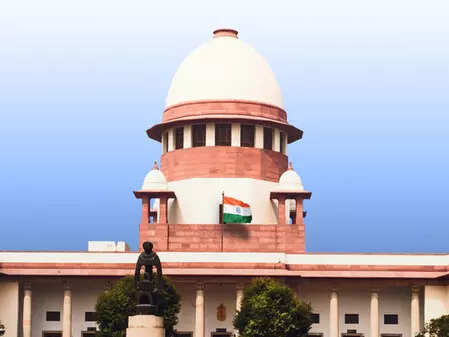
Supreme Court Orders Release Of Convict Who Was Juvenile When Crime Was Committed In 1981

The Supreme Court on Thursday (October 9) ordered the discharge of the homicide convict beneath the Juvenile Justice Act, 2000, after discovering he was a juvenile on the time of the fee of the offence in 1981. The Court held that the JJ Act is retrospective in operation, and applies to offences pre-dated the enforcement of the JJ Act, 2000.
The Court rejected the State’s argument that for the reason that offence was dedicated in 1981, the supply of the JJ Act, 2000 wouldn’t be relevant, and the legislation prevailing on the time of the offence could be relevant. Instead, a bench of Justices Dipankar Datta and A.G. Masih counting on the Constitution bench judgment of Pratap Singh v. State of Jharkhand, (2005) 3 SCC 551 and two choose bench judgment of Dharambir v. State (NCT of Delhi), (2010) 5 SCC 344 noticed that “all persons who were below the age of eighteen years on the date of commission of the offence even prior to 1st April, 2001 would be treated as juveniles even if the claim of juvenility is raised after they have attained the age of eighteen years on or before the date of commencement of the JJ Act, 2000 and were undergoing sentences upon being convicted.”
The Petitioner, who was twelve years previous on the time of the fee of the offence (homicide), moved the Supreme Court beneath Article 32 claiming that his detention exceeded the three-year restrict beneath Section 15(1)(g) of the Juvenile Justice Act, 2000, thereby violating his elementary proper to life and liberty.
In 1984, the Sessions Court convicted and sentenced the petitioner. He was directed to be saved in a youngsters’s residence as per the Indian Children Act, 1960. In 2000, the Allahabad High Court acquitted the petitioner and three co-accused permitting their attraction. However, in 2009, the Supreme Court reversed the acquittal and restored the conviction. The petitioner remained absconding and was taken into custody solely in 2022.
After the petitioner accomplished greater than three years of sentence, he filed the writ petition in Supreme Court looking for launch.
Noting that there was no dispute concerning the juvenility of the Appellant, the Court ordered the fast launch of the petitioner, a homicide convict, primarily based on the digital copy of the judgment with out ready for the licensed copy, noting his elementary proper to life and private liberty was violated.
“Since there is no quarrel with the fact that the petitioner was a child at the time of commission of the offence and the petitioner having been behind bars for more than 3 years, his liberty has been curtailed not in accordance with procedure established by law. Breach of the right guaranteed by Article 21 is writ large and, hence, the benefit of release from detention ought to be extended to the petitioner.”, the courtroom stated.
Since the Appellant has attained the age of 18 years and was convicted earlier than the graduation of JJ Act, 2000, the Court famous that he’s entitled to the profit beneath the JJ Act, 2000.
Further, the Respondent-State was unable to indicate any obstacle within the Indian Children Act, 1960 (legislation prevailing on the time of fee of offence in 1981) for the discharge of the Appellant beneath the JJ Act, 2000, the courtroom stated.
“No provision in the 1960 Act has been brought to our notice that creates a legal impediment and, thus, limits our authority to grant relief to the petitioner. Incidentally, the developments in legislation in relation to juvenile justice introduced by the Parliament from time to time can hardly be overlooked. The proviso to sub-section (2) of Section 9 of the Juvenile Justice (Care and Protection of Children) Act, 2015 is the new avatar of Section 7-A of the JJ Act, 2000. Section 7-A of the JJ Act, 2000, relevant for the present case, permits raising of a plea of juvenility in any court at any stage and even after final disposal of a special leave petition under Article 136 of the Constitution. On the plain terms of Section 7-A, the courts are under an obligation to consider the plea of juvenility and to grant appropriate relief if, at all, in an enquiry it is found that the convict was a juvenile on the date of offence.”, the courtroom noticed.
Accordingly, the attraction was allowed.
Cause Title: HANSRAJ VERSUS STATE OF U.P.
Citation : 2025 LiveLaw (SC) 993
Click right here to learn/obtain the judgment
Appearance:
Mr. Parinav Gupta, Adv. for the petitioner
Mr. Neeraj Shekar, Adv. for the respondent