The human brain ages in five ‘epochs’ or eras, a new study shows | Explained News

In probably the most complete research of its form, scientists from the University of Cambridge have discovered that the brain progresses in five “major epochs” or eras over the course of a human life.
The study printed in Nature Communications analysed the brains of three,802 individuals aged between zero and 90, utilizing datasets of MRI diffusion scans, which map neural connections by monitoring how water molecules transfer by means of brain tissue. The researchers thus discovered 4 pivotal “turning points” over the human life cycle, at round ages 9, 32, 66 and 83 years.
The study tracked how brains reconfigure and allow new methods of pondering as a individual ages.
“We know the brain’s wiring is crucial to our development, but we lack a big picture of how it changes across our lives and why,” Alexa Mousley, the lead researcher and a Gates Cambridge Scholar, instructed Cambridge University. “This study is the first to identify major phases of brain wiring across a human lifespan.”
What are the five totally different eras?
CHILDHOOD
 Era One (Dr Alexa Mousley, University of Cambridge)
During the primary interval of a individual’s life, the brain quickly will increase in dimension. However, the overabundance of connections of synapses, the connections between brain cells can also be being whittled down in what the researchers name “network consolidation”. Only the extra lively synapses survive.
The researchers additionally famous the brain’s susceptibility to psychological well being issues, even because the brain experiences a step-change in cognitive capability. The rising presence of gray matter, which processes data and controls voluntary actions, and white matter, the brain’s communication system, peaks to stabilise the cortical thickness (the space between the 2), and the cortical folding, the attribute ridges on the outer brain.
ADOLESCENCE
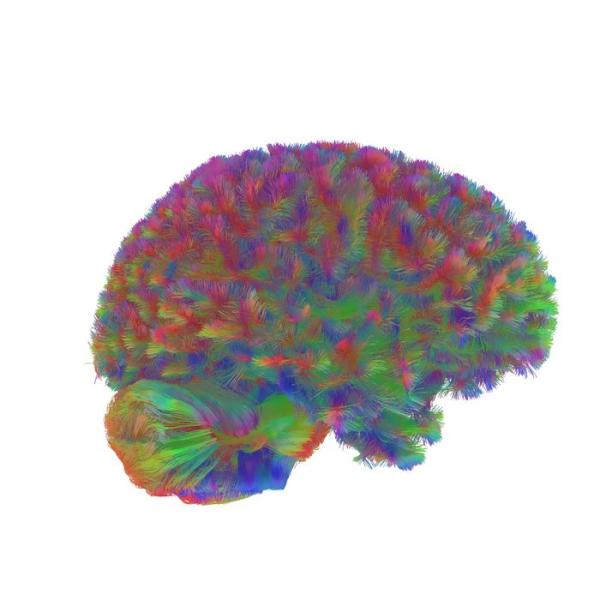 Era Two (Dr Alexa Mousley, University of Cambridge)
In the second period, the white matter in the brain continues to develop, refining the brain’s communication networks throughout this era. This is a interval of neural effectivity, marked by environment friendly connections inside particular areas in the brain and the velocity of communication throughout the brain. The result’s enhanced cognitive efficiency.
Story continues beneath this advert
Interestingly, the study shows that the method of adolescence continues till and peaks in the early thirties, the “strongest topological turning point” of the whole life span. For the longest time, it was believed that this period was restricted to the teenage years, earlier than developments in neuroscience indicated that this course of continues into a individual’s 20s.
“Around the age of 32, we see the most directional changes in wiring and the largest overall shift in trajectory, compared to all the other turning points,” stated Mousley. “While puberty offers a clear start, the end of adolescence is much harder to pin down scientifically. Based purely on neural architecture, we found that adolescent-like changes in brain structure end around the early thirties.”
ADULTHOOD
 Era Three (Dr Alexa Mousley, University of Cambridge)
According to the study, this period, starting at age 32, is the longest, spanning 30 years. The brain structure turns into steady throughout this era, which the researchers have described as a “plateau in intelligence and personality” primarily based on different research. They have additionally discovered that the totally different areas of the brain develop into extra compartmentalised, ensuing in “segregation”.
EARLY AGEING BRAIN
 Era Four (Dr Alexa Mousley, University of Cambridge)
The study notes 66 years as the subsequent turning level, though it’s comparatively milder and never indicative of main structural shifts. However, the researchers famous significant modifications in the sample of brain networks round this age. During this era, the totally different areas of the brain now not coordinate as a singular unit, however proceed to work tightly collectively.
Story continues beneath this advert
This interval additionally coincides with an incidence of dementia and hypertension, which impacts brain well being.
LATE AGEING BRAIN
 Era Five (Dr Alexa Mousley, University of Cambridge)
The remaining epoch of the brain turns into recognized at round 83 years. The study had much less knowledge for this era, given the problem of discovering wholesome brains to scan. While the brain modifications are much like early ageing, there may be a higher decline in whole-brain connectivity and elevated reliance on sure areas.
Why are these outcomes important?
The outcomes present a new template of how the human brain works, and the totally different areas of vulnerability or improvement it might expertise throughout every interval.
“Many neurodevelopmental, mental health and neurological conditions are linked to the way the brain is wired. Indeed, differences in brain wiring predict difficulties with attention, language, memory, and a whole host of different behaviours,” stated Duncan Astle, one of many co-authors of the study. “Understanding that the brain’s structural journey is not a question of steady progression, but rather one of a few major turning points, will help us identify when and how its wiring is vulnerable to disruption.”