What a new analysis says

No main city cities in India recorded protected air high quality ranges between 2015 and November 2025, in accordance with a new analysis. It additionally discovered that Delhi was essentially the most polluted metropolis throughout this era, witnessing persistently excessive Air Quality Index (AQI) values in most years.
The analysis, ‘Air Quality Assessment of Major Indian Cities (2015–2025)’, was launched on Friday (November 28) by Climate Trends, a Delhi-based local weather analysis organisation. For the research, the organisation examined annual imply AQI knowledge of 11 cities: Ahmedabad, Bengaluru, Chandigarh, Chennai, Delhi, Kolkata, Lucknow, Mumbai, Pune, Varanasi, and Visakhapatnam.
Note that when the AQI ranges between 0 and 50, the air high quality is mostly thought-about to be at a protected degree.
The findings
The newest analysis reveals that Delhi noticed the worst air high quality between 2015 and November 2025 among the many 11 examined cities. The annual imply AQI ranges had been highest in 2016 (greater than 250) within the nationwide capital, and since 2019, have seen a dip. However, they continue to be removed from protected ranges. In 2025, the AQI stood at 180.
Delhi is adopted by Lucknow, Varanasi, Ahmedabad, and Pune, all of which witnessed extended durations of elevated AQI.
“Lucknow and Varanasi started with extremely high levels (often above 200), and although both cities show steady improvement after 2019, their 2025 AQI values remain above healthy limits,” the analysis stated.
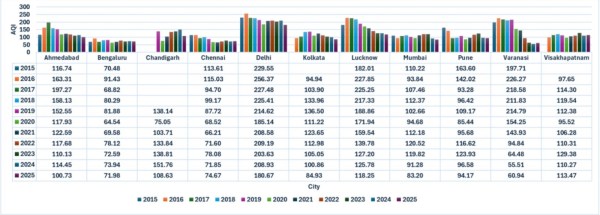 Mean AQI derived from every day AQI values for every metropolis from 2015 to twenty November 2025. Source: Central Pollution Control Board (CPCB) & Climate Trends
In comparability to those cities, Chennai, Chandigarh, Visakhapatnam, and Mumbai skilled a lot better air high quality ranges. But even in these cities, the air high quality failed to stay at wholesome ranges. The analysis revealed that in Chennai, Chandigarh, Visakhapatnam, and Mumbai, the AQI was between 80 and 140.
Story continues under this advert
While Bengaluru noticed one of the best air high quality among the many 11 cities, it didn’t witness protected AQI ranges between 2015 and November 2025. According to the analysis, town skilled AQI ranges of between 65 and 90 in most years.
 Source: Climate Trends
The causes
The important drivers of air pollution in Delhi have been vehicular emissions, industrial exercise, seasonal crop burning, and geographic elements, in accordance with the report. Note that the AQI ranges within the nationwide capital stay excessive regardless of a dip in farm fires this 12 months in the course of the winter season. That’s as a result of Delhi didn’t witness any rain, which helps wash out pollution, between October 1 and November 28, 2025.
Mahesh Palawat, vp of Meteorology and Climate Change at Skymet Weather, informed Climate Trends, “This season’s Western Disturbances have been weak and have failed to trigger widespread rainfall across North India. Without rain to wash pollutants out of the atmosphere, the pollution lingers for longer periods, leading to early and persistent smog-like conditions.”
Story continues under this advert
Meanwhile, in cities like Bengaluru, air high quality has worsened because of the rise in automobiles and visitors over time.
The analysis stated, “These findings highlight the continued impact of traffic emissions, industrial activity, seasonal factors, and rapid urbanisation across the country. The decade-long trend reinforces the need for stronger environmental policies, sustained regulatory enforcement, cleaner energy transitions, and coordinated pollution-control initiatives to safeguard public health and advance long-term urban sustainability.”